
PUSHING BAZAAR
Pushing Bazaar
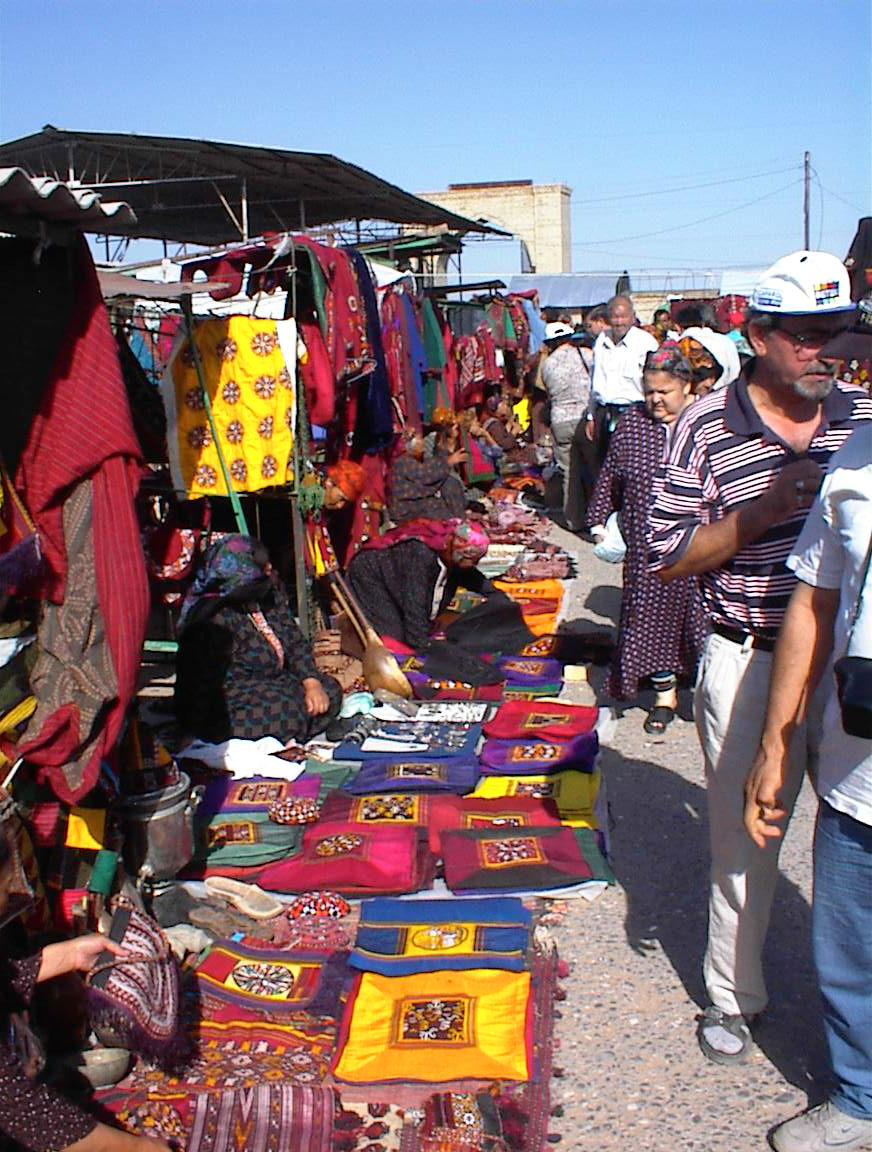
The largest market in Central Asia is the Pushing Bazaar in Ashkabad. Why ”pushing”? Because it’s packed with potential customers and onlookers, and you have to push your way through the crowd to get anywhere.
And once you’re there bargaining for something, if the action is interesting, people will push their way into the situation, offering their own assessment of the item’s value, and arguing with each other about it (in the Turkmen language – you haven’t a clue what they’re saying). It’s a pastime for them.
The place is huge, full of color, texture and sound, and is roughly divided into sections. Here’s a section for treadle sewing machines – large, heavy weight models from the former Soviet Union, ancient Singers, etc. Over there’s the section for vacuum cleaners. On and on.
I was there to work the “antique” section, which generally meant things like carpets, arts, crafts, and jewelry. Handmade articles of various kinds, often actually antique. It was a good market to buy in, and I’d found and negotiated what I was looking for.
Coincidence
But now it was time to get down to what I was really there for. My primary objective was to sell, not to buy. In the earlier part of our Silk Road trip, I’d focused on learning how to effectively negotiate there as a buyer, and had that under my belt. Now I wanted to play the other side of the game.
But unlike the merchants, I had no booth and no merchandise worth mentioning to sell. So how was I to get into a situation in which I could try my hand negotiating as a seller?
I was standing just outside the antique section, watching the crowd and searching for any clue about how I might do what I was there to do, when a woman emerged from the throng and came over to me. She wore a blue-patterned dress of the kind favored by women of the Tekke tribe.
In perfect English she asked if she could help me. I said that I certainly hoped so, but first – how was it that her English was so good? She said that she had graduated from Ohio State University. Oh, of course: a Tekke tribeswoman in the Pushing Bazaar in Ashkabad, Turkmenistan, who had graduated from Ohio State. Why hadn’t I thought of that?
I told her what I wanted to do. Without hesitation, she said to stay where I was and that she would arrange something.
In a few minutes she returned and asked me to follow. We pushed through the crowd (naturally) and came to the booth of some of her fellow tribeswomen who were selling silver jewelry.
Brief diversion: how do seemingly unlikely things like this encounter happen? Hard to say. But I like the word “coincidence” because it seems clear that some things are coinciding. Namely, trajectories. I wanted to do certain things, was on a trip to do them, had formed an intention to do something specific and was consequently on a certain trajectory. The woman helping me do this was on her own trajectory. Our trajectories briefly aligned and coincided allowing this unlikely connection to happen. Back to selling …
Jewelry Booth
They were waiting for me in a typical booth consisting of carpets spread casually on the ground, backed by more carpets and fabrics hanging from a frame behind them, with their wares arranged artfully on the rugs. They had decided that any respectable male merchant in their booth should wear the traditional merchant’s cap and slippers with the pointed, turned up toes – and they had them waiting for me. The cap fit, but not the slippers (damn! – I’d have to stay in my North Face boots).
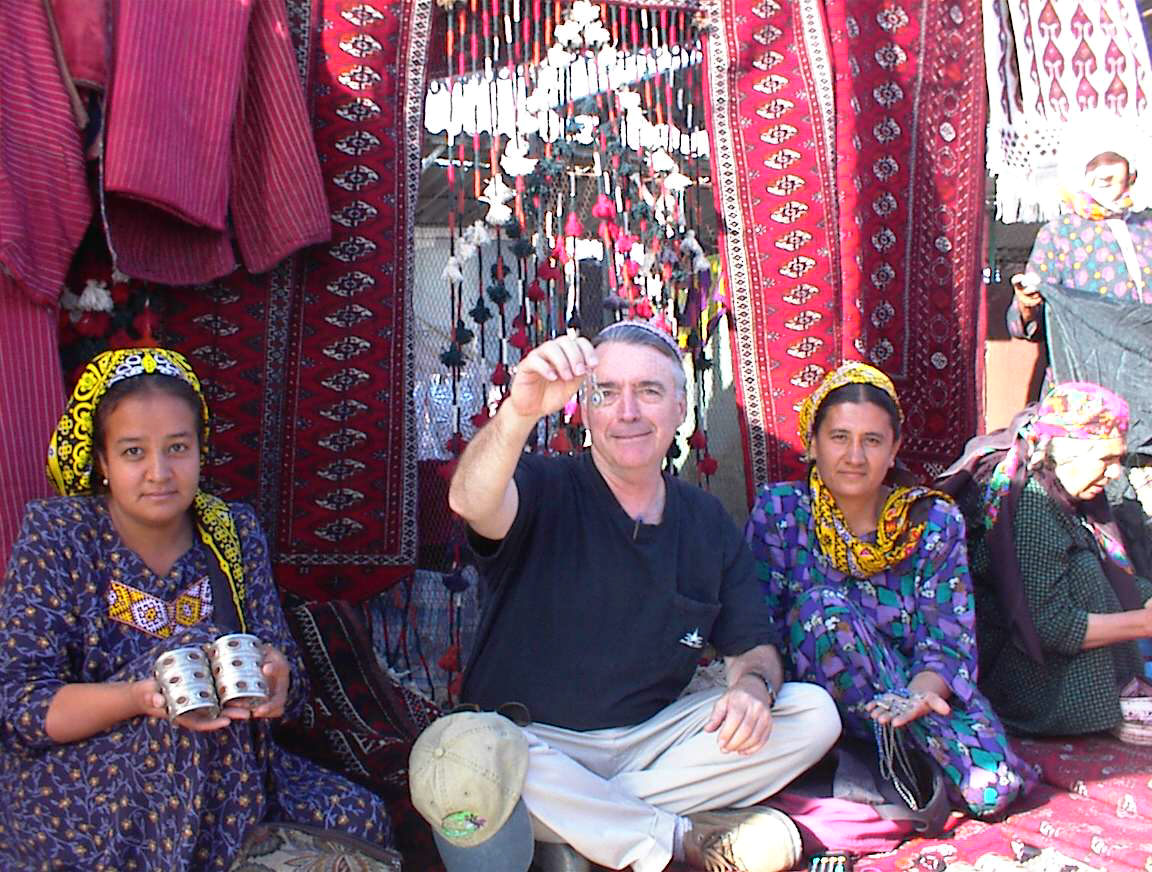
Would you buy silver jewelry from this man?
The women didn’t speak English, but my guide briefed me on some pricing ground rules (specifically walk-away prices). I would be able to hold up an item and say “First price X manat!” (manat = their currency) and from then on, as the negotiation proceeded, write the prices on a piece of paper and show it to the buyer. The women would describe the virtues of the jewelry I was selling and repeat the price in the Turkmen language. And that’s how we proceeded.
The novelty of an American tarted up as a Pushing Bazaar merchant and interacting with customers in this unusual way seemed to draw a pretty good crowd.
Silk Road selling strategy
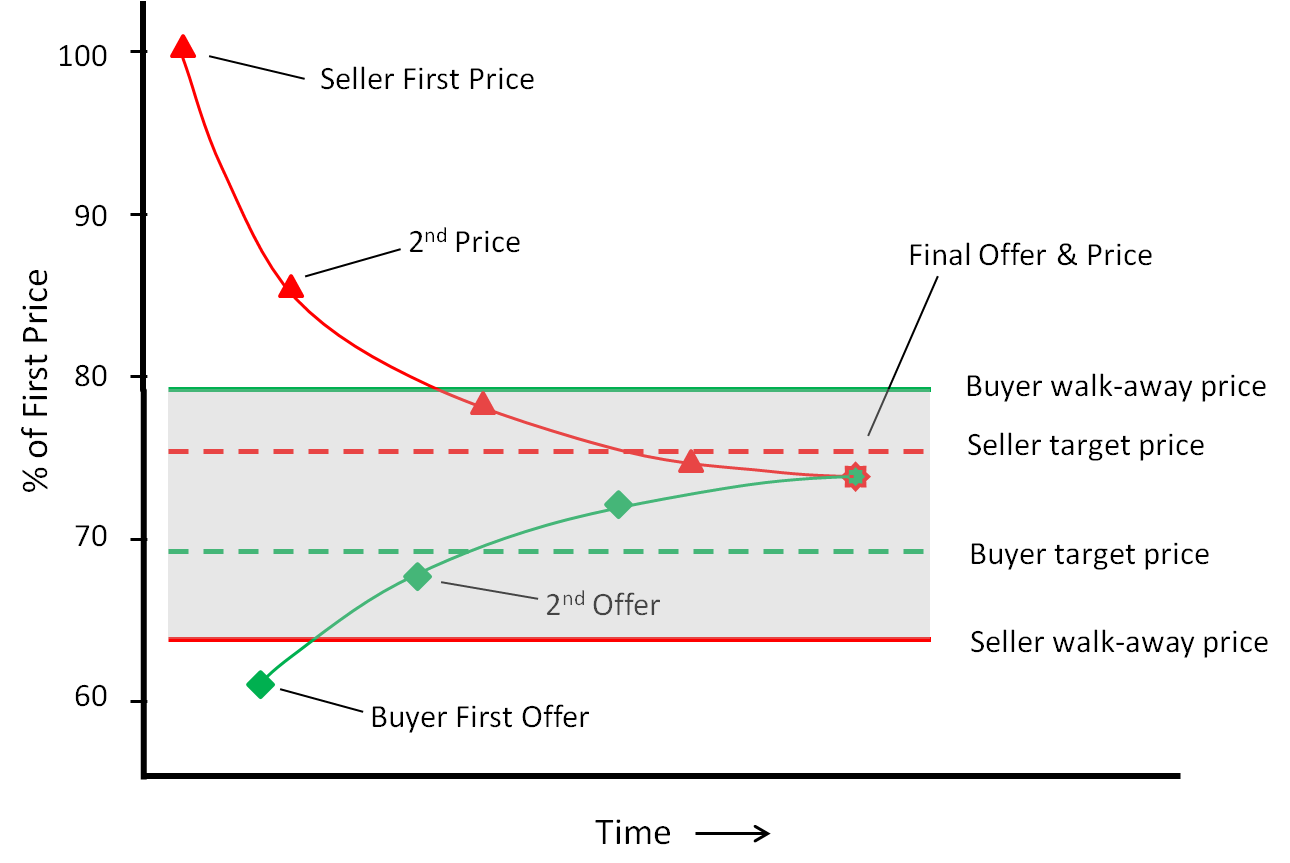
So what was the negotiation strategy? A previous post on buying strategy used the diagram below, and focused on the lower curve – representing the buyer’s offers. Here the focus is on the upper one.
Negotiating strategy
As a seller on the Silk Road, I get to set the first price (that’s the custom there). This is an advantage because it psychologically “anchors” the prices and counter offers closer to a final price I want. I set it at about 25 – 30% above the target price at which I hoped to eventually sell the item. Enough wiggle room to negotiate, but not so high that it turned off potential buyers.
Then, based on what I had learned earlier as a buyer, I lower the price pretty quickly in response to the buyer’s offers – at first, to encourage them. But then level off quickly after that to signal that I won’t go much lower. This tests their will to keep offers low, and tends to force them higher, sooner. And that tends to ensure that I end up with a final price close to, and maybe higher than, my target.
All the while, the buyer and I are both obscuring our intentions, each creating a gray area for the other to try to see though, while making their moves. Meanwhile, the seller’s strategy is to control the rate of change of the price during the negotiation to guide the buyer to a final offer that’s near the seller’s target.
This, together with the buyer’s strategy described in the companion post lays out a good way to negotiate in places like the Silk Road. Both are based on rate of change of the prices or counter-offers, and both create trajectories that hopefully converge in a mutually acceptable final offer and price.
But this isn’t just for the Silk Road. These strategies work well for essentially any negotiations for anything, anywhere, as long as they take place over an exchange of several prices and counter offers.
End game
OK, so how did it go in the jewelry booth? Pretty well. I sold a few items for the ladies, and they seemed happy with the results. And then I bought some jewelry, myself. It only occurred to me afterward that this may have been their motivation for allowing me to play merchant for them in the first place!! As I pointed out in the companion post, the women merchants in Central Asia are really smart. In any case: win/win.
And that’s how it works, when it’s working, on the Silk Road.
_______________________________________________________________________
Readers are encouraged to add comments to this post.
And if you’d like to share or recommend the post, click on your preferred way in the left margin sidebar.
If you’re not currently being automatically notified when new posts are published, then please Follow Real Strategy (top of right hand column on this page), and indicate how you’d prefer to be notified.
For other posts of interest, look in the Smart Menu.


14 Responses to Negotiating Strategy; Selling on the Silk Road